


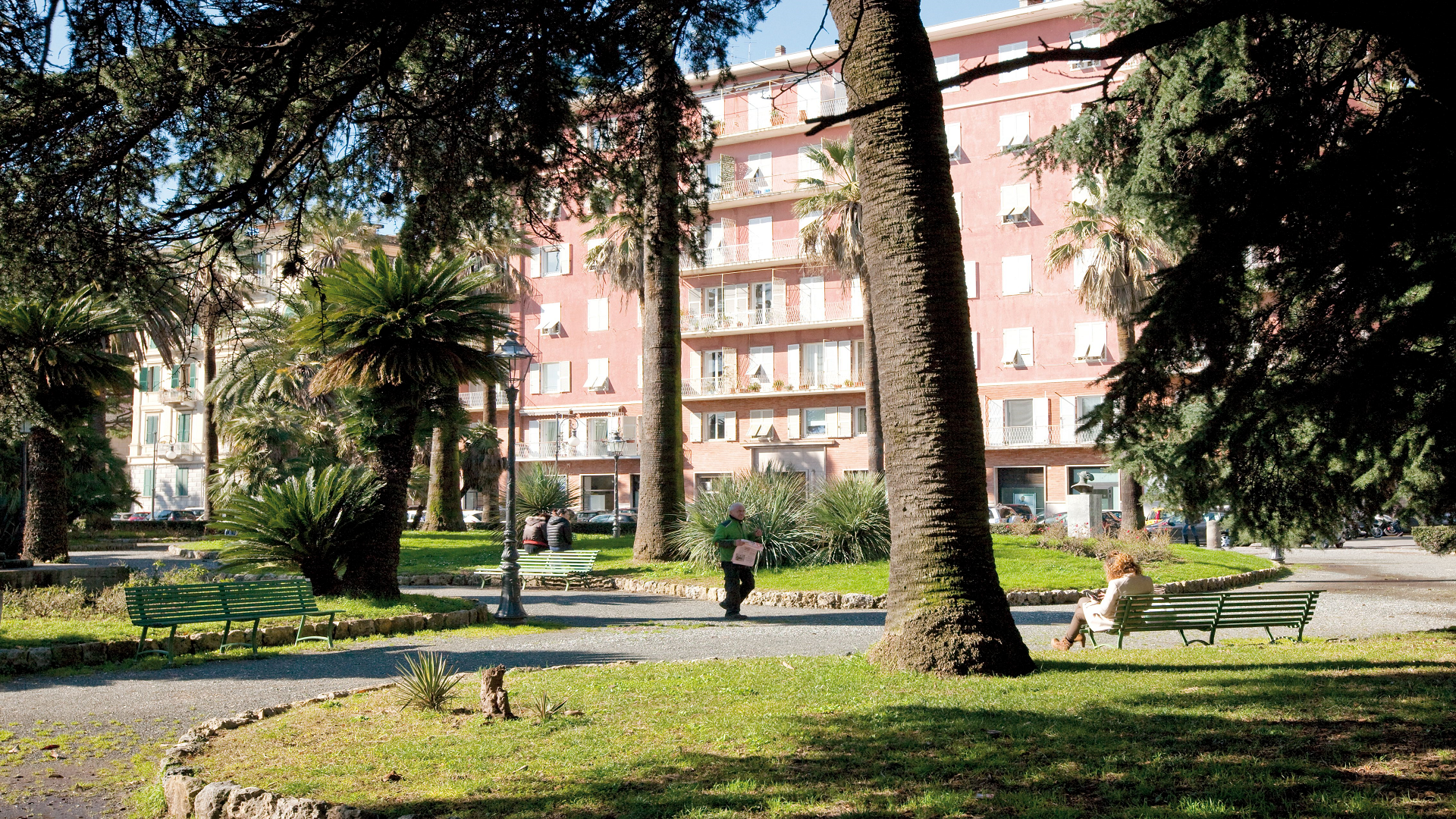
Historical gardens: Porta Rocca
The Porta Rocca gardens belong to the historical gardens and were created after that the garden areas close to the sea had been extended, following the ancient road to Sarzana and running at the foot of the hill where the Capuchin monks lived. When this hill was demolished, the city gained two separate surfaces – one was squared and the other one was rectangular, separated by Via XX Settembre.
The rectangular area was decorated with a large round flowerbed, whereas the squared area consisted of two opposite diagonals converging at an angle. The sections of the lateral secondary streets suggest the symmetry of the composition reached with later interventions.
In 1913, the monument to Giuseppe Garibaldi, one of the founding fathers of modern Italy, was placed within the gardens and that required a renovation of the garden layout. The project was assigned to painter Felice del Santo, a member of the City Development Commission and the author of the Gardens close to the sea of 1987.
The project requested the construction of a series of curvilinear flowerbeds leading the sight of the observer towards the central flowerbed, in a shape of a hill, on top of which stands the monument rocky support.
The hill was demolished in the 30’s and the earth resulting from the excavation works was used to create road embarkments in the plain of Migliarina. In 1934, the project established the extension of the gardens up to Palazzo Ferrari, with the addition of palm trees and magnolia trees. The adjacent building was completed with a square-shaped turf decorated with small trees arranged in a circle.
In 1960, the monument in honor to those who died in any war was placed in these gardens.